The Role of Scissor Lifts in Large Scale Indoor and Outdoor Events
Behind every polished concert, trade show, or corporate gala is a crew racing the clock to hang lights, mount signage, and dress a venue from floor to ceiling. Much of that work happens well above head height, where safety and speed can’t be compromised. Scissor lifts have become the equipment crews rely on to reach those elevated areas efficiently and securely. They provide a stable platform, boost productivity, and adapt to both cramped indoor halls and sprawling outdoor grounds. This post explains the role scissor lifts play in large-scale events, covering safe elevated access, faster setup and teardown, indoor venue challenges, outdoor installations, and the productivity gains crews see across every phase of an event.
Reaching Elevated Areas Safely
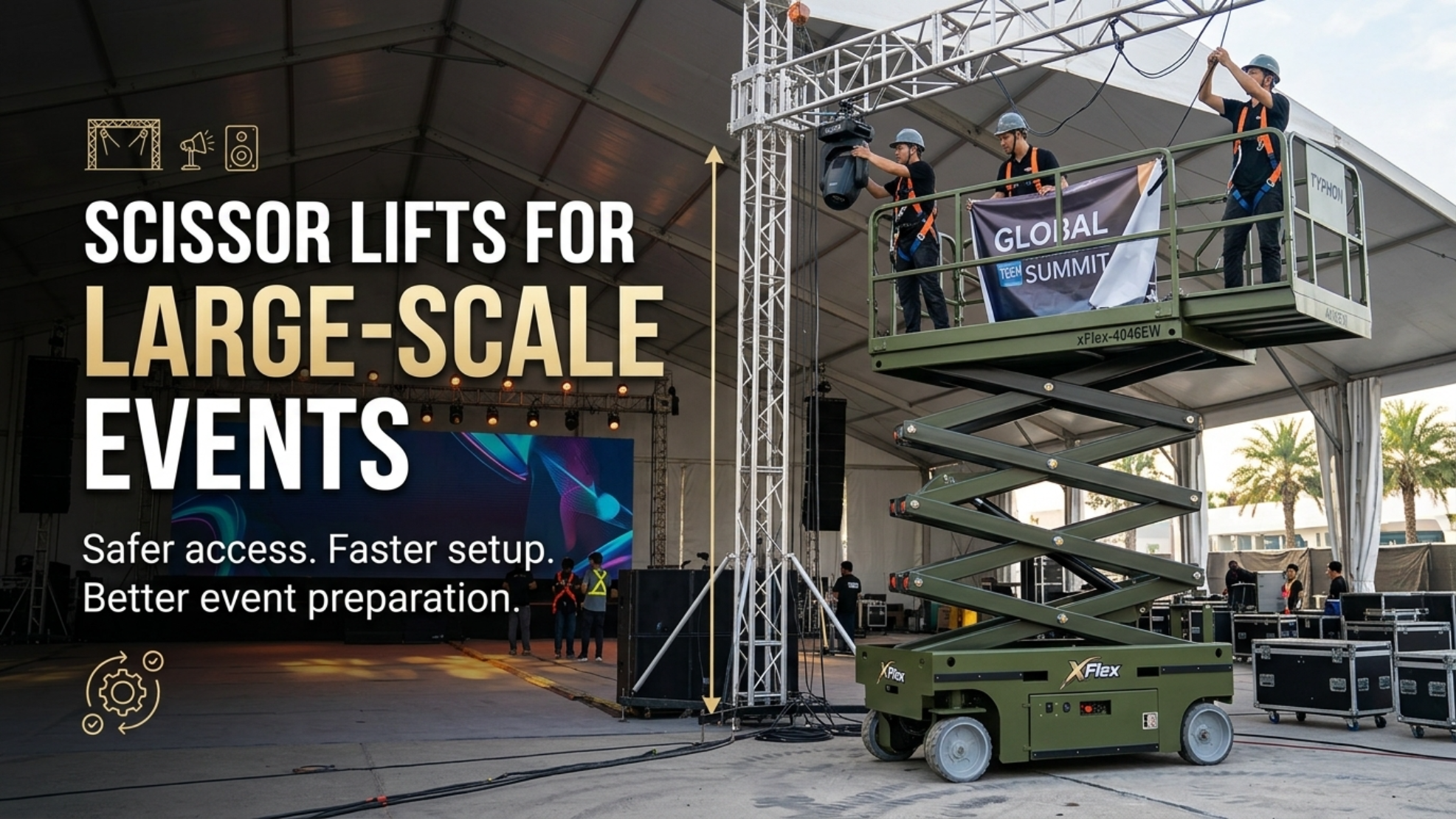
Large events depend on work that happens high above the floor, and safety at those heights is non-negotiable. A scissor lift raises workers on a broad, guarded platform that stays level and stable while they focus on the task in front of them. Unlike a ladder that wobbles or forces awkward reaching, the lift keeps crew members squarely over their work with room to move, hold tools, and handle materials. That stability is the foundation of every safe elevated installation at an event.
The range of overhead work at a large event is considerable, and a scissor lift supports it all from one dependable platform:
- Lighting, positioning fixtures, trusses, and rigging at precise heights.
- Banners and signage, hanging and aligning large displays evenly across a space.
- Decorations, installing drapery, florals, and ceiling treatments securely.
- Elevated installations, mounting speakers, screens, and other overhead equipment.
Each of these tasks demands both height and control, which is exactly what the platform delivers.
The guardrails, stable base, and generous deck space give workers the confidence to concentrate on quality rather than balance. When a crew member can stand securely and reach their work without straining, installations go up straighter, faster, and safer. That combination of stable vertical access and a protected working area is why scissor lifts have become the trusted choice for elevated event work, protecting both the people on the platform and everyone on the floor below.
Supporting Fast Event Setup and Teardown
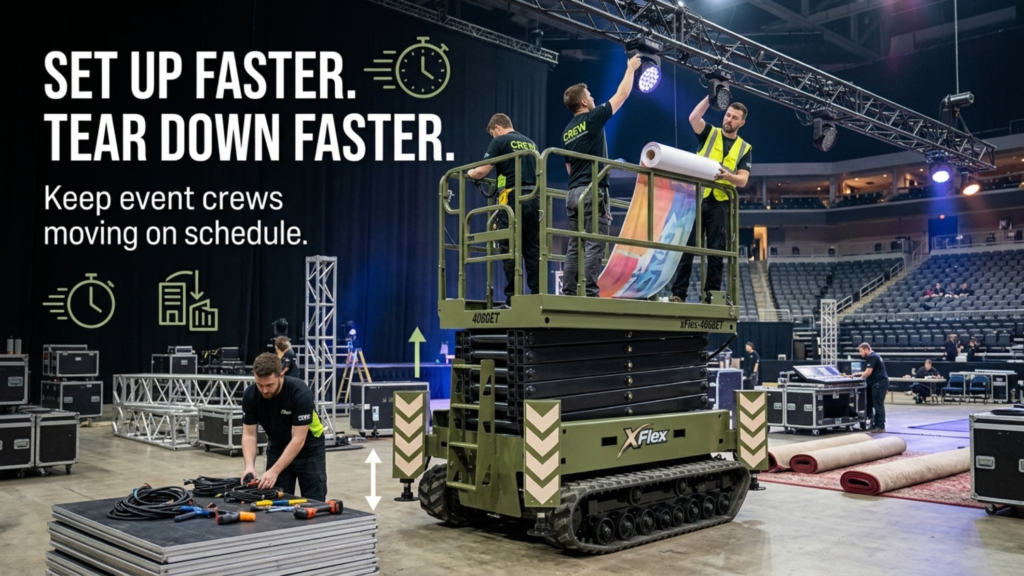
Event timelines are unforgiving. Venues are often booked back to back, leaving crews a narrow window to transform an empty space and, later, to strip it down just as quickly. A scissor lift directly addresses that pressure by letting workers move efficiently between elevated work areas. Instead of climbing down, relocating a ladder, and climbing back up for every fixture, a crew can raise the platform, complete the task, lower it, and roll to the next spot in a fraction of the time.
That efficiency compounds across the hundreds of overhead tasks a large event requires. During installation, a lift keeps the work flowing smoothly from one lighting position to the next, or across a long run of signage, without the constant interruptions that slow a crew down. When the platform carries both the worker and the materials, there’s no repeated trips up and down to fetch tools or components, and the whole sequence tightens.
Teardown benefits just as much, and often matters even more. Once an event ends, the pressure to clear the venue is intense, and every minute saved protects the schedule and the budget. A scissor lift lets crews dismantle rigging, remove signage, and strike decorations quickly and in order, working steadily through the space rather than fighting the clock. By speeding up both installation before the event and dismantling after it, the lift becomes a genuine timesaver at the two moments when time is tightest, helping crews hit their deadlines with less stress and fewer overruns.
Handling Indoor Venue Challenges
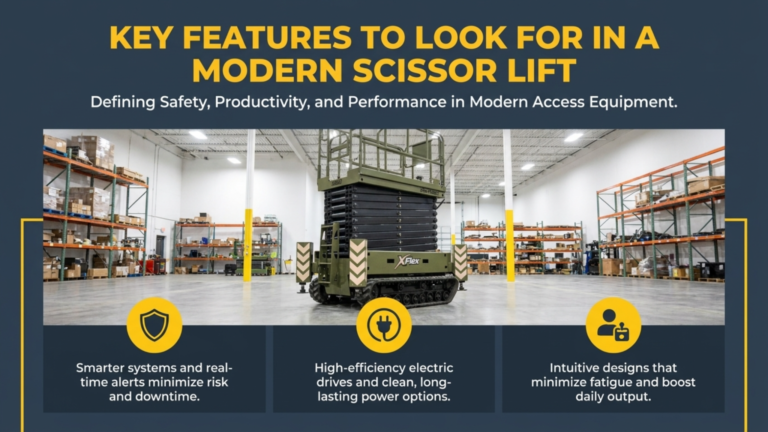
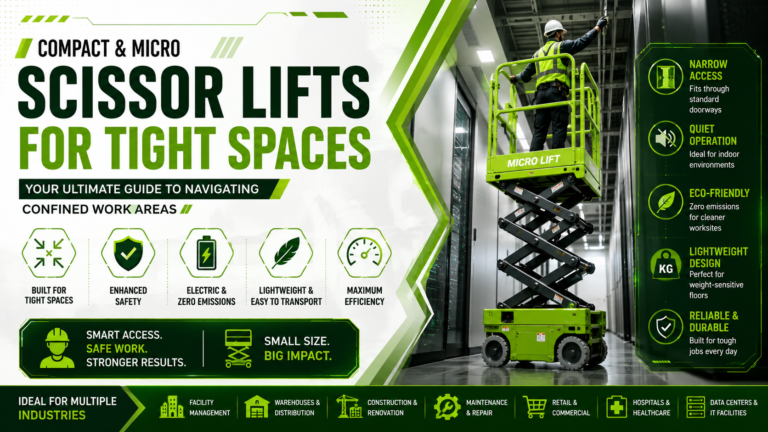
Indoor venues bring their own set of demands, and scissor lifts are well suited to meet them. Convention centers, arenas, and exhibition halls are busy, enclosed spaces where crews often work around finished floors, tight aisles, and other trades operating nearby. Compact and electric scissor lifts are built precisely for these conditions, offering the reach crews need without the drawbacks that larger or fuel-powered machines would introduce indoors.
Two features make these lifts especially valuable inside a venue:
- Compact size, allowing the lift to navigate narrow aisles, fit through standard doorways, and work in the confined areas common to packed exhibition floors.
- Electric, low-emission operation, producing no exhaust fumes and running quietly, which keeps indoor air clean and the environment comfortable for crews and staff.
Together, these qualities let the equipment operate where space and air quality both matter.
Space is often the tightest constraint indoors, and a maneuverable lift makes a real difference. Crews can position the platform close to their work in crowded booths, backstage areas, or between rows of seating without disrupting everything around them. Non-marking tires and a smaller footprint protect polished floors and let the lift move through areas where a bulky machine simply couldn’t go.
Low-emission operation is equally important in an enclosed hall. Electric power means no fumes to ventilate and far less noise, which keeps working conditions safe and pleasant during long setup shifts. For the specialized demands of indoor venues, compact electric scissor lifts deliver the reach, mobility, and clean operation that keep event work moving smoothly.
Tackling Outdoor Event Installations
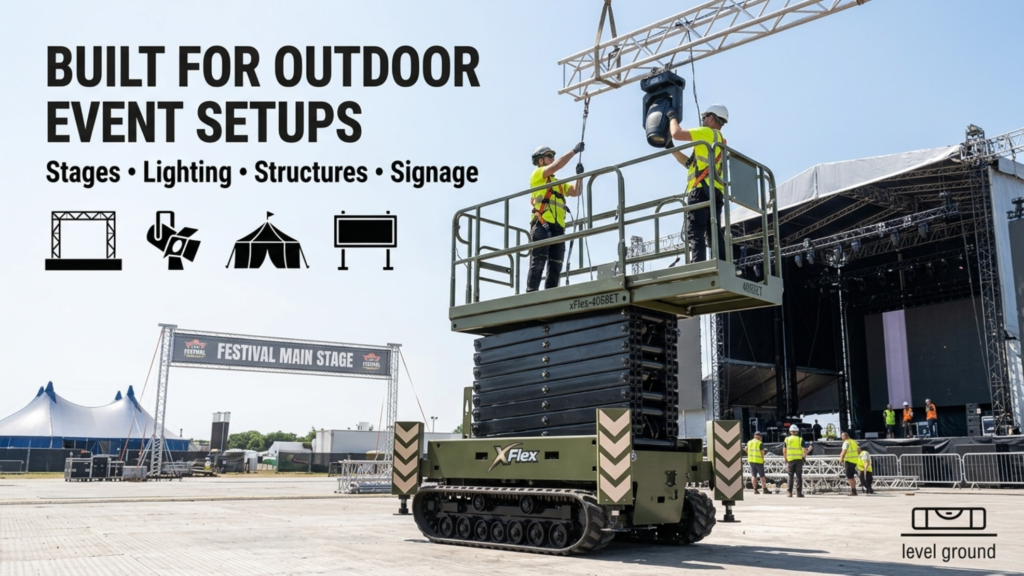
Outdoor events shift the challenge from tight spaces to wide-open grounds, and here too scissor lifts prove their worth. Festivals, outdoor concerts, and large public gatherings require significant elevated work to build the structures and systems that make the event function. A scissor lift provides a practical, stable platform for that work, giving crews secure access to heights across the site when set up on appropriate, level surfaces.
The scope of outdoor elevated work is broad, and a lift supports the core installations that define an event:
- Stages, assembling overhead elements and rigging above the performance area.
- Temporary structures, building and securing tents, frames, and support systems.
- Lighting systems, mounting and aiming fixtures across large outdoor spans.
- Signage, installing wayfinding, sponsor displays, and entrance markers at height.
Each of these tasks calls for reliable elevated access, which the platform provides across the site.
The key consideration outdoors is the surface beneath the lift. A scissor lift performs best and safest on firm, level ground, so crews should assess the terrain and prepare a stable base before raising the platform. On suitable surfaces, the lift delivers the same steady, guarded working area it provides indoors, letting workers focus on precise, quality installation.
Used correctly and matched to the ground conditions, a scissor lift becomes an indispensable tool for outdoor event builds. It gives crews dependable elevated access for the stages, structures, lighting, and signage that bring a large outdoor event to life, all from a platform they can trust when the site is properly prepared.
Improving Productivity Across Event Crews
Beyond safety and reach, the greatest advantage a scissor lift offers is productivity. Event crews work under constant time pressure across large areas, and the equipment they use shapes how much they can accomplish. A scissor lift functions as a dedicated elevated work platform, replacing the slower, more limited methods crews might otherwise fall back on and letting them get more done in every shift.
Consider the alternatives. Ladders restrict a worker to a fixed spot, offer little room for tools or materials, and demand constant repositioning that eats up time and invites fatigue. Other equipment pressed into elevated service often needs to be moved and reset repeatedly, interrupting the flow of work. A scissor lift eliminates these bottlenecks by providing a spacious, stable platform that a worker can raise, use, lower, and reposition quickly, carrying tools and materials along for the ride.
That dedicated platform improves productivity across the full arc of an event:
- Setup, moving efficiently between elevated tasks without the delays of ladder work.
- Maintenance, reaching fixtures and displays quickly to make adjustments during an event.
- Teardown, dismantling overhead elements in an organized, efficient sequence.
Each phase benefits from the same steady, uninterrupted access.
When a crew works from a scissor lift instead of climbing ladders or shuffling other machines around, individual tasks go faster and the entire operation runs more smoothly. Workers stay on the platform and focus on the job rather than climbing up and down or waiting for equipment to be repositioned. That efficiency lets crews cover more ground, meet tight deadlines, and maintain quality throughout, making the scissor lift a genuine driver of productivity for event teams of every size.
Conclusion
Scissor lifts have earned their place as essential equipment for large-scale events, indoors and out. They deliver stable, secure access for lighting, signage, decorations, and elevated installations, while speeding up both setup and teardown when the schedule is tightest. Compact electric models handle the space and air-quality demands of indoor venues, and sturdy platforms tackle outdoor stages, structures, and signage on properly prepared ground. Above all, a scissor lift works as a dedicated elevated platform that keeps crews productive from the first fixture to the final strike. Planning your next event? Assess the elevated work involved, match the right scissor lift to your venue and surface conditions, and give your crew the safe, efficient platform they need to deliver a flawless event on schedule.