Top 7 Uses of a Scissor Lift in Construction and Maintenance
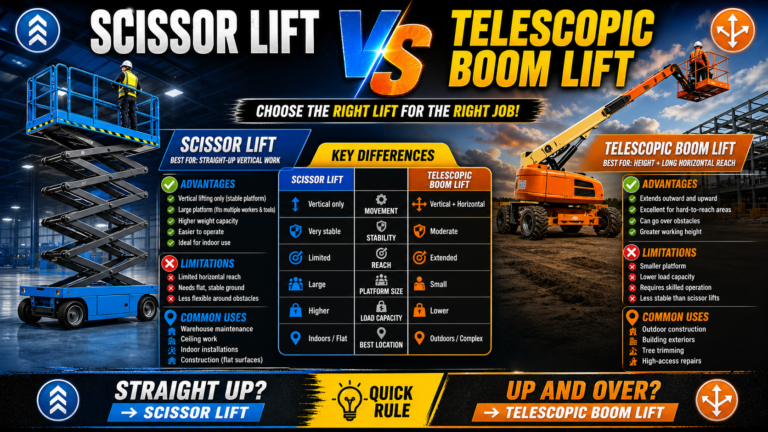
The main advantage of a scissor lift is simple: it helps people work higher with better stability and productivity. Unlike a boom lift, which reaches up and outward, a scissor lift is designed mostly for straight vertical lifting. This makes it ideal for indoor maintenance, warehouse work, ceiling repairs, painting, electrical installation, HVAC service, and many construction tasks where workers need a stable platform directly above the machine.
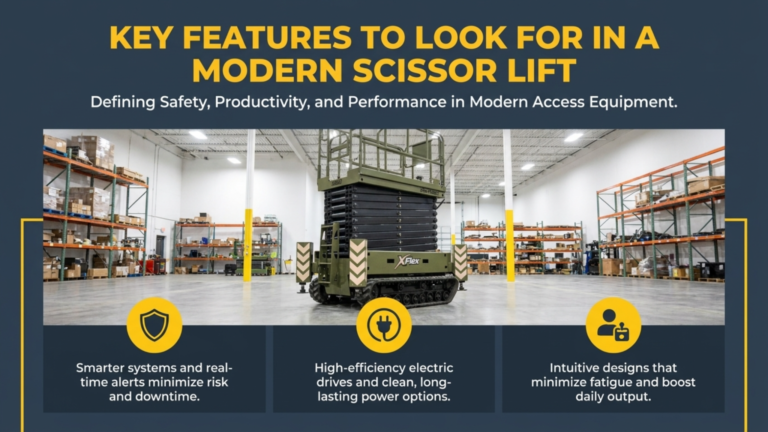
Scissor lifts are available in different sizes and power types. Compact electric scissor lifts are popular for indoor jobs because they are quieter and cleaner. Larger electric or rough-terrain models are useful for construction sites, exterior building work, and maintenance projects that require more height or platform space. Some models are walk-behind, some are self-propelled, and some include outriggers or tracks for extra stability and traction.
In this guide, we will cover the top 7 uses of a scissor lift in construction and maintenance, explain why each use matters, and share important safety and buying considerations for contractors, facility managers, warehouse teams, and equipment owners.

1. Ceiling Installation and Overhead Construction Work
One of the most common uses of a scissor lift is overhead construction work. Many jobs require workers to reach ceilings or upper wall areas for long periods of time. This includes installing ceiling panels, insulation, sprinkler systems, ductwork, wiring, pipes, and structural components.
A scissor lift is ideal for these jobs because it provides a flat platform with space for workers and tools. Instead of constantly climbing up and down a ladder, workers can stand on the platform and focus on the task. This can save time and reduce fatigue, especially during long installation projects.
Common overhead construction jobs include:
- Installing ceiling panels
- Running electrical conduit
- Installing sprinkler systems
- Mounting pipes and ductwork
- Working on steel or metal framing
- Installing insulation or ceiling supports
- Setting up overhead safety equipment
For contractors, this type of work is often repeated across many rooms or building sections. A scissor lift helps crews move from one work area to another while keeping tools nearby. On smooth indoor floors, electric scissor lifts are especially useful because they are quiet, compact, and easy to position.
The key benefit is productivity. Workers can complete more overhead tasks with fewer interruptions, and they can carry the tools they need on the platform instead of climbing down every few minutes.

2. Electrical, Lighting, and Sign Installation
Another major use of a scissor lift is electrical and lighting work. Electricians and maintenance teams often need to install, replace, inspect, or repair lighting systems in warehouses, retail buildings, factories, schools, gyms, parking garages, and commercial properties.
Lighting work can be difficult with ladders because the job may require both hands, tools, replacement parts, and stable positioning. A scissor lift gives workers a safer and more comfortable platform for this type of task.
Scissor lifts are commonly used for:
- Replacing warehouse lights
- Installing LED lighting systems
- Repairing ceiling fixtures
- Running electrical wiring
- Installing security cameras
- Mounting commercial signs
- Maintaining parking garage lights
- Servicing outdoor building lights
For signage, scissor lifts are useful because they allow workers to position signs at a consistent height. They can also support tools and hardware on the platform, helping installers work faster and more accurately.
Electric scissor lifts are especially popular for indoor lighting and electrical work because they produce no exhaust at the work area and are easier to use in finished buildings. For taller spaces, a 40 ft class scissor lift may be suitable, while smaller indoor jobs may only need a 20 ft platform height depending on the building.
When choosing a scissor lift for electrical or lighting work, always consider platform height, working height, machine width, floor condition, load capacity, and whether the lift needs to pass through standard doors or narrow aisles.

3. Painting, Drywall, and Interior Finishing
Scissor lifts are also valuable for painting, drywall, and finishing work. Interior finishing jobs often require workers to cover large wall or ceiling areas while carrying tools, paint, joint compound, tape, rollers, sprayers, and other materials.
Using a ladder for this work can be slow because workers must move the ladder repeatedly. Temporary scaffolding can provide more space, but it takes time to set up, move, and take down. A scissor lift gives painters and finishing crews an efficient middle ground: a mobile elevated platform that can be raised, lowered, and repositioned as needed.
Scissor lifts support finishing tasks such as:
- Painting high walls
- Painting ceilings
- Drywall finishing
- Sanding and patching
- Installing trim or panels
- Applying coatings
- Interior renovation work
- Commercial building touch-ups
For large indoor spaces, such as warehouses, showrooms, churches, sports facilities, and factories, a scissor lift can greatly improve workflow. Workers can cover wider sections from the platform and move along the wall or ceiling area with less downtime.
Platform size is important for this type of work. A wider platform gives workers more room for paint buckets, rollers, sprayers, and finishing tools. Some scissor lifts also include a platform extension, which helps workers reach slightly farther without repositioning the whole machine.
For professional finishing work, a scissor lift can help improve both speed and quality. Workers have better balance, more tool space, and a more comfortable working position compared with standing on a ladder for long periods.
4. HVAC Installation and Maintenance
Heating, ventilation, and air conditioning work often requires access to ceilings, rooftops, ducts, vents, filters, and mechanical systems. Because many HVAC components are installed overhead, scissor lifts are extremely useful for both installation and maintenance.
HVAC technicians use scissor lifts to reach:
- Air ducts
- Ventilation systems
- Ceiling-mounted units
- Exhaust fans
- Pipes and hangers
- Rooftop access points
- Filters and service panels
- Commercial HVAC equipment
A scissor lift is useful because HVAC work often requires tools, parts, and both hands. Technicians may need to remove covers, connect ducts, tighten fasteners, install hangers, inspect airflow, or service equipment. A stable platform gives them enough space to work more safely and efficiently.
In new construction, scissor lifts help HVAC crews install ductwork before the ceiling is finished. In maintenance, they help technicians reach existing systems in warehouses, offices, schools, hospitals, factories, and retail spaces.
For indoor HVAC jobs, electric scissor lifts are often preferred because they are quiet and cleaner for enclosed spaces. For outdoor mechanical work or rougher surfaces, a tracked or rough-terrain style scissor lift may be better depending on ground conditions.
The right scissor lift can reduce setup time and make HVAC service more efficient, especially when technicians need to move across several work zones in one building.
5. Warehouse Rack, Inventory, and Facility Maintenance
Warehouses are one of the best environments for scissor lifts. Many warehouses have tall racks, high lighting, overhead doors, sprinkler systems, fans, signs, and security cameras. Maintenance teams need a reliable way to reach these areas without disrupting daily operations.
Scissor lifts are used in warehouses for:
- Rack inspection
- Inventory access
- Light replacement
- Sprinkler system inspection
- Security camera installation
- Overhead door maintenance
- Fan and ventilation service
- Building repairs
- Signage and label installation
Compared with ladders, a scissor lift gives workers a larger and more stable platform. This is important when working near shelves, tools, or elevated equipment. A compact electric scissor lift can move through aisles and work in narrow areas where larger machines may not fit.
For warehouse operations, machine size matters. Buyers should consider the overall width, turning radius, platform height, and floor load limits. A smaller electric scissor lift may be better for tight aisles, while a larger platform may be better for maintenance jobs that require multiple workers or more tools.
Scissor lifts are also helpful for facility managers because they reduce dependence on outside service companies for simple maintenance tasks. With trained operators and the right lift, teams can complete routine overhead maintenance faster and more consistently.
6. Building Inspection and Repair Work
Scissor lifts are commonly used for inspection and repair work because they allow workers to reach elevated areas with a clear view and stable platform. Inspectors, contractors, and maintenance teams may need to check walls, ceilings, beams, windows, roofing edges, gutters, cladding, and structural elements.
A scissor lift helps with inspection tasks such as:
- Checking ceiling damage
- Inspecting roof edges
- Examining exterior walls
- Repairing gutters
- Inspecting beams and supports
- Checking cracks or leaks
- Reviewing fire safety systems
- Performing routine building maintenance
For property owners and maintenance teams, inspections are important because small problems can become expensive if they are ignored. A scissor lift allows teams to reach areas that would be difficult or unsafe with a ladder.
Repair work is also easier because workers can bring tools and materials with them. For example, if a team needs to repair a high wall, replace a panel, patch a leak, or fix a sign, the platform provides more working room than a ladder.
In construction, inspections may also be required before the next stage of work begins. A scissor lift helps supervisors and inspectors check elevated areas quickly without building temporary access every time.
The result is better access, faster inspection, and more professional maintenance work.
7. Outdoor Construction, Maintenance, and Jobsite Support
Although many people think of scissor lifts as indoor machines, they are also useful for outdoor construction and maintenance. Outdoor jobs may require higher reach, stronger traction, larger platforms, or stabilizing outriggers. Depending on the model, a scissor lift can support exterior building work, siding, windows, signs, roofing edges, and general construction access.
Outdoor scissor lift uses include:
- Exterior wall work
- Window installation
- Sign installation
- Siding and cladding support
- Roof edge access
- Building maintenance
- Outdoor lighting repair
- Construction inspection
- Steel structure support
- Facility repair
For outdoor work, the ground condition is very important. Smooth concrete is different from gravel, dirt, grass, or uneven construction terrain. Contractors should choose a lift designed for the work surface. Wheeled electric models are good for smooth surfaces, while tracked or rough-terrain models may be better for uneven ground or areas that need more traction.
Outdoor work also requires extra attention to weather. Wind, rain, slope, soft ground, and surface holes can affect stability. Operators should always follow the manufacturer’s instructions and never raise a lift in unsafe conditions.
When properly selected and operated, a scissor lift can be a powerful jobsite support machine. It gives workers access to height while keeping the platform stable and organized.
Why Scissor Lifts Are Important for Construction and Maintenance
Scissor lifts are important because they help teams work at height with better efficiency. Many construction and maintenance jobs require workers to stay elevated for long periods. A ladder may work for a quick task, but it is not always the best choice for repeated or professional work.
A scissor lift provides several advantages:
- More stable platform than a ladder
- More space for tools and materials
- Better productivity for overhead work
- Easier movement across large work areas
- Useful for indoor and outdoor jobs
- Multiple height options
- Cleaner electric operation for indoor spaces
- Better comfort for long maintenance tasks
For contractors, scissor lifts can reduce labor time and make projects more organized. For warehouses and facilities, they make routine maintenance easier. For property owners, they can improve safety and reduce delays during repair work.
How to Choose the Right Scissor Lift
Choosing the right scissor lift depends on the job. Before buying or renting, consider these important factors:
Platform height: Make sure the lift reaches the work area. Remember that platform height and working height are not always the same.
Load capacity: Check how much weight the platform can hold, including workers, tools, and materials.
Platform size: A larger platform gives more room, while a compact platform is better for tight spaces.
Indoor or outdoor use: Electric wheeled lifts are great indoors. Tracked or rough-terrain models may be better outdoors.
Ground condition: Smooth concrete, gravel, dirt, and slopes all require different machine considerations.
Power source: Electric models are cleaner and quieter. Other power options may be better for heavy outdoor jobs.
Machine width: Make sure the lift can pass through doors, gates, aisles, and worksite access points.
Stabilization: Some taller or outdoor models use outriggers for additional stability.
The right scissor lift should match the height, surface, space, load, and daily work requirements.
Basic Scissor Lift Safety Tips
Scissor lifts are useful machines, but safety must always come first. Operators should be trained, and the lift should be inspected before use. The work area should also be checked for hazards such as holes, slopes, overhead power lines, moving vehicles, falling objects, and unstable surfaces.
Important safety tips include:
- Inspect the lift before operation
- Check tires, controls, brakes, guardrails, and emergency stop
- Keep both feet on the platform floor
- Do not climb on guardrails
- Do not exceed the rated load capacity
- Keep the platform gate closed
- Avoid moving the lift while elevated unless allowed by the manufacturer
- Watch for overhead hazards
- Do not use the lift in unsafe wind or weather
- Use the lift only on suitable ground conditions
- Follow the manufacturer’s manual
Conclusion
A scissor lift is one of the most useful machines for construction and maintenance work. It helps workers reach elevated areas with more stability, more platform space, and better productivity than many traditional access methods. From ceiling installation and electrical work to painting, HVAC service, warehouse maintenance, inspections, and outdoor construction support, a scissor lift can handle many important jobs.
The top 7 uses of a scissor lift are overhead construction, lighting and electrical work, painting and finishing, HVAC installation, warehouse maintenance, building inspection, and outdoor jobsite support. Each of these tasks requires safe and efficient access to height, which is exactly what a scissor lift is designed to provide.
For contractors, facility managers, warehouse teams, and property owners, choosing the right scissor lift can save time, reduce labor, and improve daily work performance. Whether you need a compact indoor electric model or a taller platform for larger jobs, the right scissor lift can make elevated work faster, safer, and more professional.
Explore reliable scissor lift equipment for your next project at Machinery.org.
FAQ
What is a scissor lift used for?
A scissor lift is used to raise workers and tools to elevated work areas. It is commonly used for construction, maintenance, painting, lighting, HVAC, warehouse work, inspections, and facility repairs.
Is a scissor lift good for construction?
Yes. A scissor lift is very useful in construction because it provides a stable elevated platform for overhead work, electrical installation, ceiling work, building inspection, and exterior maintenance.
Can a scissor lift be used indoors?
Yes. Electric scissor lifts are commonly used indoors because they are quiet, clean, and suitable for warehouses, offices, commercial buildings, factories, and maintenance facilities.
Can a scissor lift be used outdoors?
Yes, but the model must match the ground and job conditions. Outdoor work may require a rough-terrain, tracked, or stabilized scissor lift depending on the surface and height requirement.
What is the difference between platform height and working height?
Platform height is the height of the platform floor. Working height usually includes the worker’s reach above the platform, so it is higher than the platform height.
What jobs are best for a scissor lift?
The best jobs for a scissor lift include ceiling installation, lighting repair, painting, HVAC maintenance, warehouse rack inspection, sign installation, and building repairs.
Is a scissor lift safer than a ladder?
A scissor lift can provide a more stable platform and more working space than a ladder, but it must be used correctly. Operators should be trained, the machine should be inspected, and all safety rules must be followed.