
Zero Tail Swing vs. Conventional Excavators: Key Differences and Best Applications
Choosing between a zero tail swing and a conventional excavator is one of the most important decisions you will make when matching equipment to a job. The two designs look similar at first glance, yet they behave very differently the moment the machine begins to rotate. One is built to work safely in cramped, crowded spaces, while the other is built to deliver maximum stability and power on open ground. Understanding how each design works, where it excels, and where it falls short helps you select the right machine for your projects. This guide breaks down what sets these excavators apart and shows you how to choose the one that fits your work best.
What Is a Zero Tail Swing Excavator?
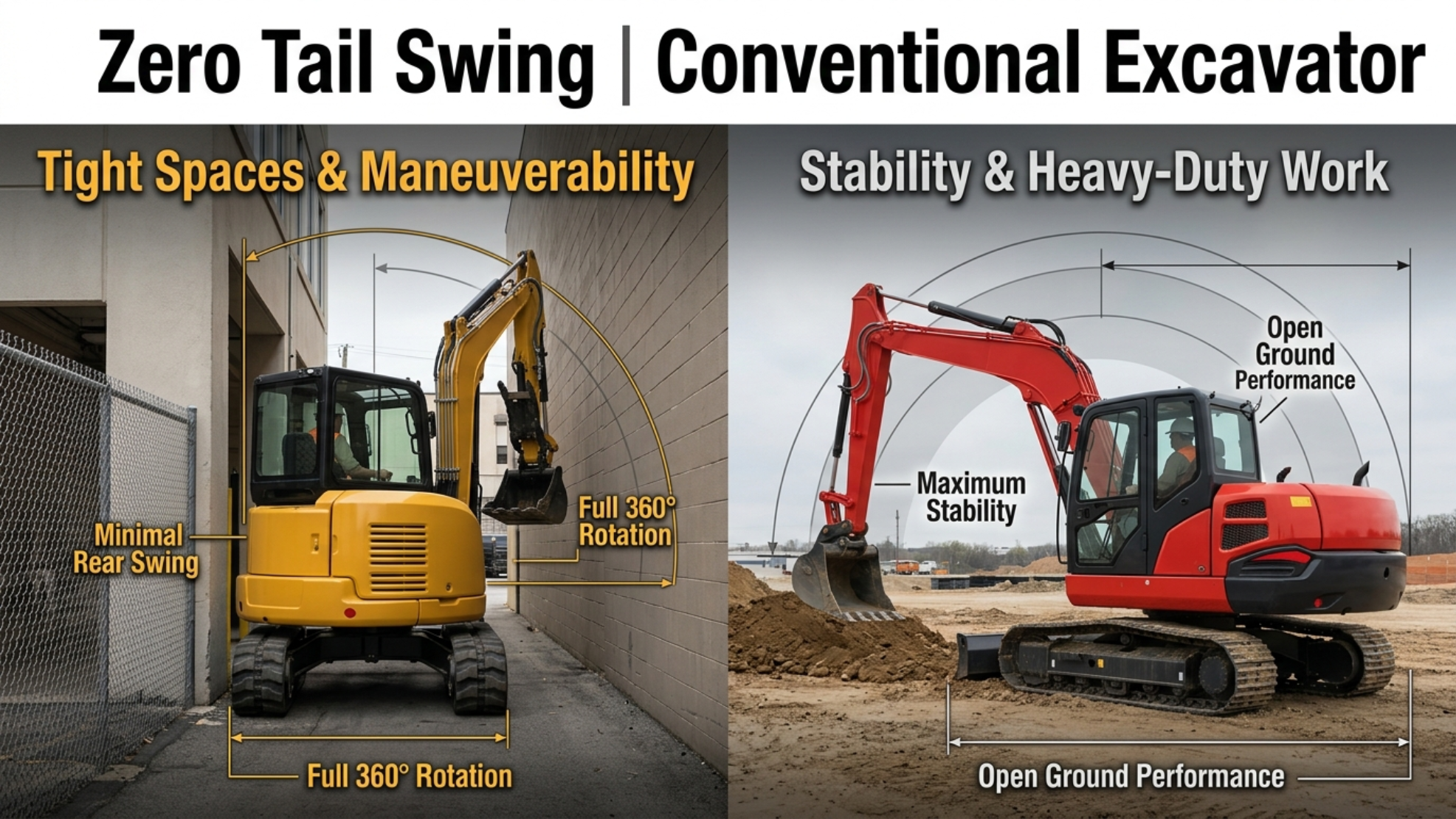
A zero tail swing excavator is engineered around one clever principle: the rear of the machine stays within the width of the tracks as the upper structure rotates. On a conventional machine, the counterweight at the back swings out past the tracks when the operator turns the cab, but a zero tail swing design keeps that rear end tucked inside the track footprint. This means the machine can spin a full 360 degrees without any part of it extending beyond the width of its base, which changes everything about how and where it can work.
That compact design delivers two benefits that matter enormously in tight conditions. First, it improves maneuverability, letting the operator rotate and reposition the machine confidently in spaces where a conventional excavator would be forced to stop and reset. Second, it reduces the risk of striking nearby objects, since the rear cannot swing into walls, fences, parked vehicles, or other equipment during rotation.
These advantages make a real difference in confined work areas:
- Tight urban sites where buildings and traffic leave little room to spare.
- Work alongside structures, where a swinging counterweight would risk contact.
- Crowded job sites with equipment, materials, and people close by.
- Narrow access areas that a wider-swinging machine simply cannot enter safely.
For anyone working in close quarters, the value of this design is clear. The operator can focus on the task rather than constantly watching the rear of the machine, and the reduced collision risk protects both the equipment and everything around it. A zero tail swing excavator turns spaces that once seemed too tight into workable job sites, giving contractors a dependable, safe option where room is at a premium and precision matters most.
How Conventional Excavators Differ
Conventional excavators take the opposite approach, and that difference comes down to the counterweight at the rear of the machine. On a conventional design, this counterweight extends beyond the tracks when the upper structure rotates, so the tail end swings out past the width of the base during every turn. That overhang is not a flaw; it is a deliberate engineering choice that gives the conventional excavator its own distinct set of strengths, making it the traditional workhorse for a wide range of demanding jobs.
The projecting counterweight serves an important purpose. By placing that mass farther back from the machine’s center, the design often provides greater stability and lifting capacity, counterbalancing heavy loads at the front and helping the machine stay planted when digging hard or lifting at reach. For work that pushes an excavator to its limits, that added stability and power translate into confident, capable performance under load.
The trade-off, of course, is space. Because the rear swings beyond the tracks, a conventional excavator requires more operating space to work safely, and the operator must always account for that overhang during rotation.
Several qualities define how a conventional excavator performs:
- Extended counterweight that swings past the tracks during rotation.
- Greater stability that supports heavy digging and lifting with confidence.
- Higher lifting capacity that suits demanding, load-intensive tasks.
- Larger space requirements that call for open, uncongested job sites.
Understanding these characteristics helps clarify where a conventional machine belongs. Its stability and lifting strength make it a powerful choice for jobs with plenty of room, while its swinging tail makes it less suited to cramped, crowded environments. When space allows, that traditional design delivers the muscle and steadiness that heavy work demands.
Comparing Performance and Stability
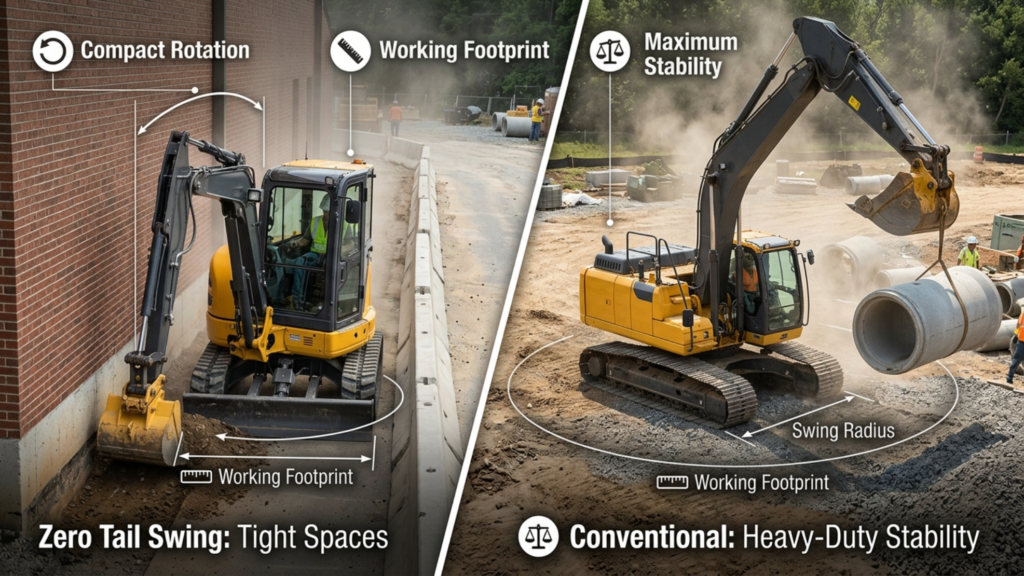
Both excavator types are highly capable machines, and both offer excellent digging capabilities that get the job done. The difference lies not in whether they can dig, but in the conditions where each performs at its best. Zero tail swing and conventional designs each carry distinct strengths, and recognizing those strengths is the key to understanding which machine will serve a given task most effectively. Neither is universally better; each simply shines in different circumstances.
Zero tail swing models excel in tight environments, where their compact rotation is a decisive advantage. In a crowded site, alongside a building, or within a narrow work zone, the ability to rotate fully without swinging past the tracks lets these machines work productively where a conventional excavator would struggle. The operator gains precision and confidence in close quarters, completing work safely in spaces that would otherwise be difficult or off-limits.
Conventional excavators, by contrast, typically perform better in heavy lifting and demanding excavation tasks. Their extended counterweight delivers the stability and lifting capacity that intensive work requires, letting them handle heavier loads and dig aggressively into tough ground with steady, planted confidence.
The performance comparison comes down to a few clear distinctions:
- Digging capability, where both types perform strongly and reliably.
- Tight-space performance, where zero tail swing models hold a clear edge.
- Heavy lifting and stability, where conventional excavators lead.
- Working footprint, compact for zero tail swing and larger for conventional.
Seen this way, the choice becomes less about which machine is superior and more about which strengths your work demands. A job defined by confined space rewards the zero tail swing design, while one defined by heavy loads and open ground rewards the conventional. Matching the machine’s strengths to the task at hand is what delivers the best results.
Best Applications for Each Excavator Type
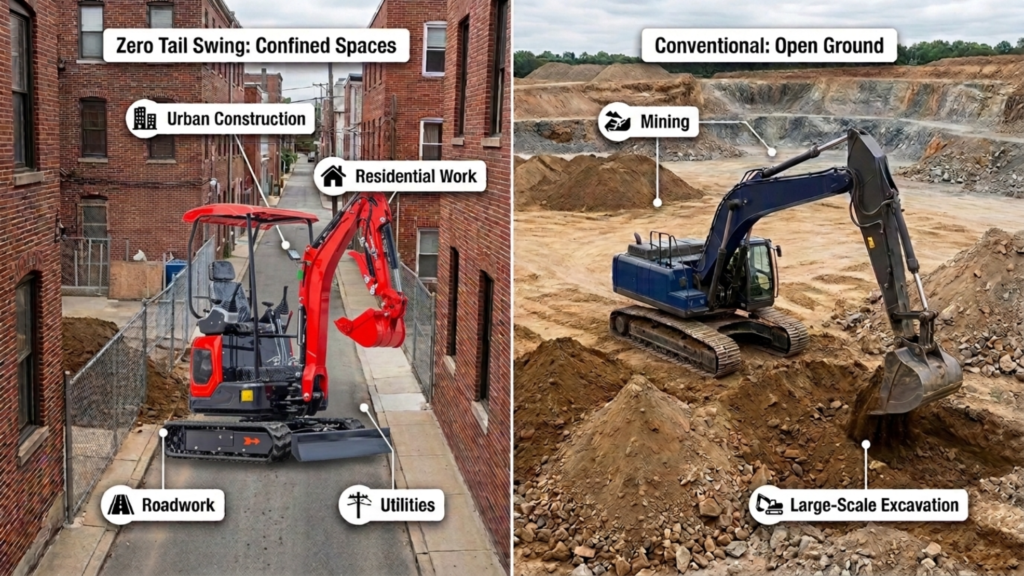
Because each design carries its own strengths, each also has clear applications where it delivers the best value. Matching the machine to the environment is the surest way to maximize productivity and safety, and the ideal setting for one type is often the wrong setting for the other. Knowing where each excavator belongs takes much of the guesswork out of choosing equipment for a project.
Zero tail swing excavators are ideal for work where space is limited and precision is essential. Their compact rotation lets them operate safely in crowded, confined settings that would challenge a larger-swinging machine.
These machines excel across several common applications:
- Urban construction, where buildings, traffic, and pedestrians crowd the site.
- Residential projects, with tight yards, fences, and structures close at hand.
- Roadwork, often performed in narrow lanes beside active traffic.
- Utility installations, where digging happens in restricted, congested corridors.
Conventional excavators, on the other hand, are better suited for large-scale work on open ground, where their stability and lifting capacity can be put to full use without space constraints getting in the way.
They perform best in demanding, spacious environments:
- Large-scale construction, where heavy digging and lifting drive the work.
- Mining operations, which call for powerful, sustained excavation.
- Quarrying, where the machine handles tough material at scale.
- Open job sites with ample room for the machine to rotate freely.
Understanding these applications helps you avoid a costly mismatch. Putting a conventional excavator on a cramped urban site invites collisions and slows the work, while sending a zero tail swing machine to handle heavy quarry loads may push it beyond its comfort zone. When you match the machine to the setting it was designed for, both productivity and safety improve, and the equipment delivers exactly the performance the job requires.
Choosing the Right Excavator for Your Project
Selecting between a zero tail swing and a conventional excavator ultimately comes down to a clear, honest look at your work. The best choice depends on your work environment, your lifting requirements, and the operating space available on your job sites. Rather than assuming one design is superior, the smart approach is to weigh these factors against the demands you face most often, then choose the machine that fits those realities. Getting this decision right sets the foundation for efficient, safe, and productive work.
Start by evaluating your typical job site conditions and project demands. A few key questions point you toward the right choice:
- How much space do you usually have to work in, from tight urban lots to open ground?
- How heavy are the loads you lift and how demanding is the excavation you perform?
- How often do you work close to buildings, traffic, or other obstacles?
- What balance of maneuverability and lifting power does your work truly require?
Answering these honestly reveals which design serves you best. If your work regularly takes you into confined, crowded spaces where a swinging tail would create risk, a zero tail swing excavator offers the maneuverability and safety those conditions demand. If your projects involve heavy lifting and demanding excavation on open ground, a conventional machine delivers the stability and capacity that kind of work requires.
The goal throughout is to select the excavator that delivers the best balance of productivity, safety, and efficiency for your specific needs. A machine matched thoughtfully to your environment works faster, protects your crew and surroundings, and holds up dependably to the tasks you throw at it. Take the time to assess your conditions carefully, and you will end up with equipment that performs reliably and earns its place on your job sites for years to come.