
Skid Steer Standard Trencher vs. Trench Backfiller: What’s the Difference?
Digging a trench and filling it back in are two very different jobs, and the attachments built for each reflect that. A standard trencher and a trench backfiller often work on the same project, one right after the other, yet they serve opposite purposes. Knowing how each one performs helps you match the right tool to the task, avoid wasted labor, and keep your projects moving on schedule. This post explains the difference clearly, covering how each attachment works, when it comes into play during a job, the productivity each delivers, and how to decide which one your project actually needs.
Cutting Trenches vs. Refilling Them
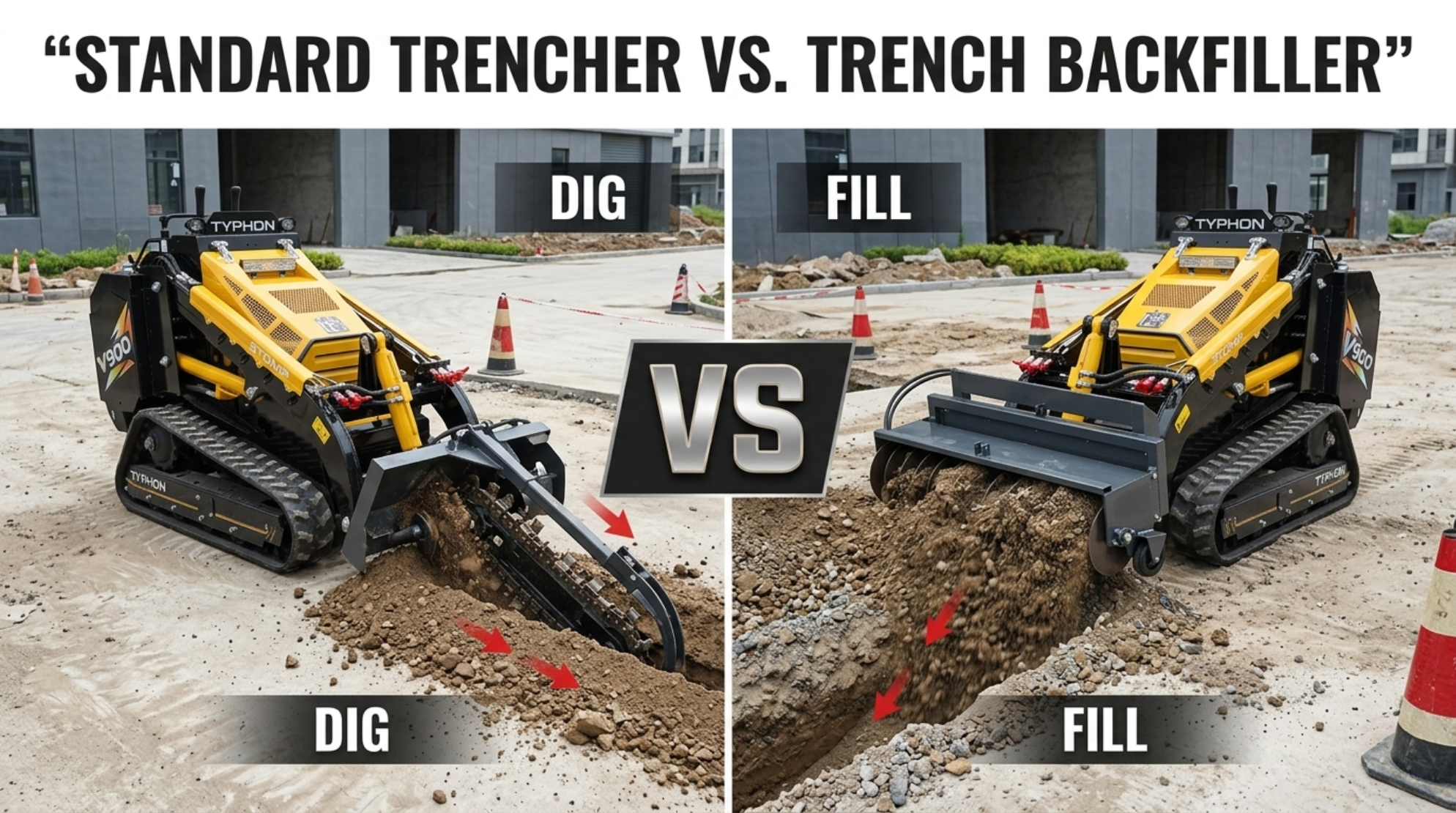
The most fundamental difference between these two attachments comes down to a simple contrast: one opens the ground, and the other closes it back up. A standard trencher is designed to cut narrow, uniform channels into the earth. It carves precise trenches for a wide range of underground work, giving contractors the clean, consistent openings that quality installation depends on. Whenever a project calls for burying something below the surface, the trencher is the tool that creates the path for it.
A trench backfiller does the opposite job. Rather than digging into the ground, it pushes loose excavated soil back into an open trench once the installation is complete. After a pipe, cable, or line has been laid, the backfiller returns the displaced material to the channel quickly and efficiently, replacing the slow, tiring work of shoveling by hand.
The two attachments handle distinct phases of trenching work:
- Standard trencher: cuts narrow, uniform channels for utilities, irrigation, drainage, and other underground installations.
- Trench backfiller: pushes loose excavated soil back into the open trench after the installation is finished.
Because each attachment addresses a separate stage of the process, they complement one another rather than compete. The trencher handles the demanding work of breaking ground and creating a clean channel, while the backfiller takes care of the equally important task of closing that channel back up. Understanding this basic division of labor is the first step toward choosing the right attachment, since it clarifies exactly what each tool contributes to a trenching project from start to finish.
How Each Attachment Works
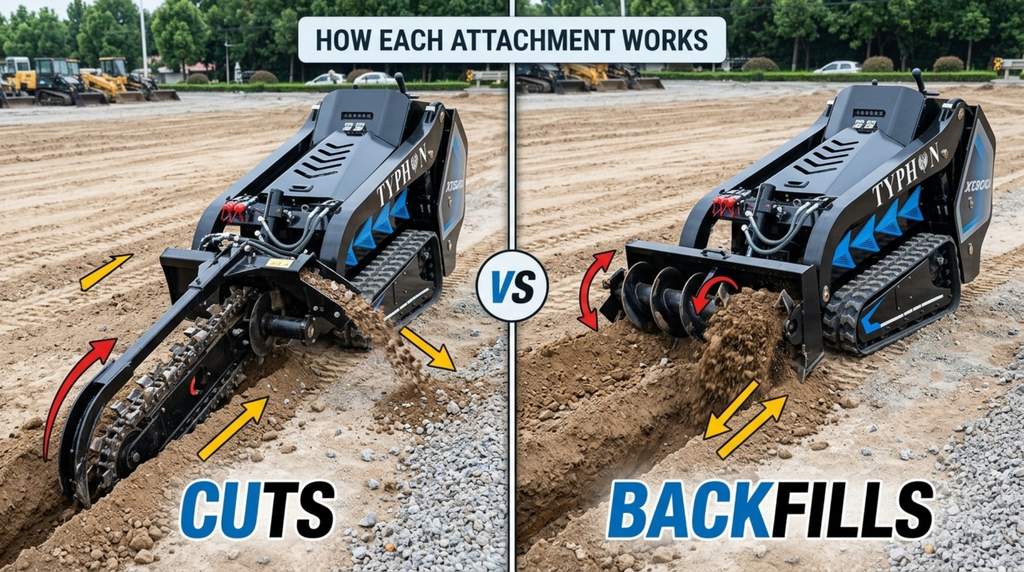
The mechanics behind each attachment explain why they perform such different roles. A standard trencher relies on a high-torque rotating chain fitted with cutting teeth. As the chain spins around its boom, the teeth bite aggressively into the soil, breaking through the ground to carve a channel of consistent width and depth. The high torque is what allows the attachment to power through tough, compacted, or root-filled earth, producing a clean, uniform trench ready for whatever needs to go into it. As the skid steer moves along the trench line, the chain does the hard work of excavation while casting the loosened soil to the side.
A trench backfiller works in an entirely different way. Instead of cutting, it uses a sweeping or pushing action to move excavated material back into an open trench. The soil that the trencher cast aside during digging sits in a windrow alongside the channel, and the backfiller sweeps that loose material back where it came from in a controlled, efficient motion.
This difference in mechanics reflects the purpose each attachment serves:
- The trencher applies concentrated cutting force through its rotating chain to break ground and form the channel.
- The backfiller applies a broad sweeping or pushing motion to return loose soil to the trench.
Neither action could easily replace the other, which is exactly why the two attachments exist as separate tools. Cutting a trench demands the focused, powerful chain of a trencher, while refilling one calls for the wide, sweeping reach of a backfiller. Each design is optimized for its specific stage of the work, and that specialization is what makes both attachments so effective at the tasks they were built to handle.
Different Stages of the Job
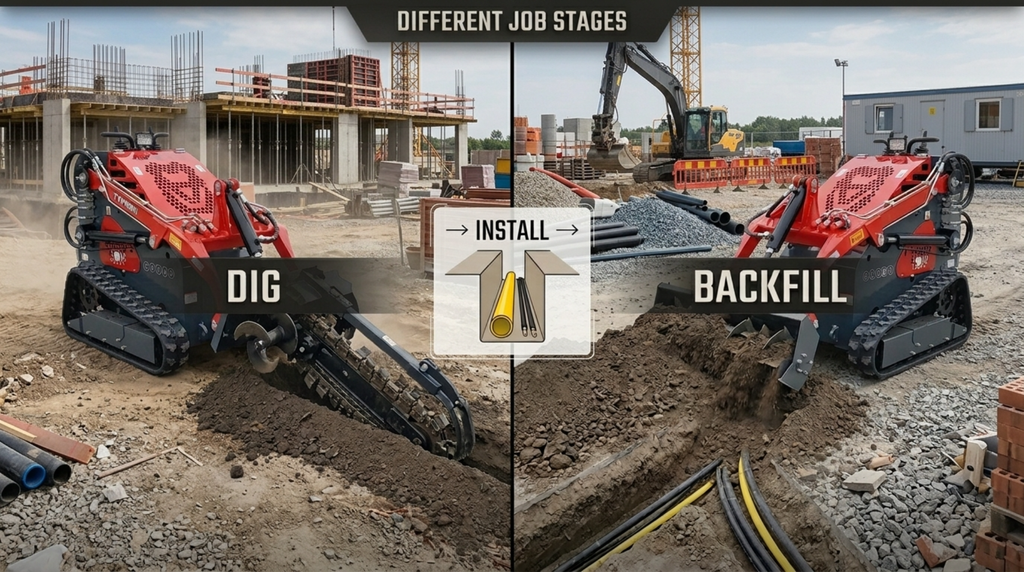
Timing is the clearest way to understand how these attachments relate to one another, because each belongs to a distinct stage of a trenching project. The standard trencher comes first. It’s used during the excavation stage, before any pipes, cables, or utility lines go into the ground. Its job is to open the channel and prepare the path, creating the clean, properly sized trench that the installation work depends on. Until the trencher has done its part, there’s no channel for the crew to work with.
The trench backfiller enters the picture at the opposite end of the process. Once the trench is open and the pipe, cable, or line has been laid in place, the backfiller is used to cover and refill the channel. It closes out the job by returning the excavated soil, restoring the surface and completing the sequence that the trencher began. Because the backfiller works only after installation, it never competes with the trencher for the same task.
This sequence makes the two attachments complementary rather than interchangeable. You wouldn’t reach for a backfiller to open a trench, and you wouldn’t use a trencher to close one. Instead, they hand the work off to each other: the trencher digs, the crew installs, and the backfiller fills. Seeing the two tools as partners in a single workflow, each responsible for a different stage, helps clarify why many contractors value having both on hand. Together they cover the full arc of a trenching job, from the first cut through the final fill, with each attachment stepping in exactly when its particular strength is needed most.
Productivity and Labor Savings
Both attachments share a common benefit that makes them so valuable to contractors: they dramatically reduce manual labor and speed up trenching projects. Trenching by hand is slow, physically demanding, and hard on a crew, and backfilling by shovel is often just as exhausting. These skid steer attachments take over the heaviest parts of the work, letting a small crew accomplish far more in a fraction of the time.
The standard trencher delivers its savings on the digging side of the job. Cutting a precise, uniform channel by hand would take enormous effort and hours of labor, but the trencher’s rotating chain does that work quickly and consistently. This minimizes the physical effort required to create clean trenches and lets crews open long runs of channel far faster than manual digging ever could, keeping projects on pace and freeing workers for other tasks.
The trench backfiller provides its savings on the opposite end. Returning excavated soil to a trench by hand means hours of tiring shoveling, especially on long installations. The backfiller eliminates much of that manual effort by sweeping the loose material back into the trench in efficient passes.
The productivity gains from each attachment show up clearly:
- The trencher reduces the labor and time needed to dig precise, consistent channels.
- The backfiller removes most of the manual shoveling involved in refilling open trenches.
Taken together, these attachments transform a labor-intensive process into an efficient, machine-driven workflow. Crews spend less energy on grueling manual work and complete projects faster, which lowers costs and improves output across the board. Whether you’re focused on opening trenches, closing them, or both, each attachment offers meaningful savings in time and effort that add up quickly over the course of a project.
Choosing the Right Attachment for Your Project
Deciding which attachment you need starts with a simple question: is your primary task creating a trench or closing one? The answer points you directly toward the right tool. If your work centers on excavation, such as opening channels for utilities, irrigation lines, or drainage systems, a standard trencher is the attachment that gets the job done. If your work involves refilling trenches that have already been dug and fitted with pipe or cable, a trench backfiller is what you need to finish efficiently.
For many contractors, though, the honest answer is that they handle both stages of the work, and that’s where owning both attachments delivers the greatest value. Professionals who take on complete projects from start to finish benefit from having each tool ready to play its part in a smooth, continuous workflow.
Consider the kinds of projects where both attachments earn their keep:
- Utility installation, where crews dig trenches, lay lines, and refill in a continuous sequence.
- Irrigation systems, which require opening channels for pipe and quickly restoring the surface afterward.
- Landscaping, where trenching and backfilling both factor into drainage, edging, and installation work.
- Drainage projects, which involve cutting channels and closing them back up once the system is in place.
Contractors managing these kinds of complete jobs gain real efficiency from pairing the two attachments. The trencher opens the ground, the crew completes the installation, and the backfiller closes everything up, all with the same skid steer. By matching your attachment choice to the actual scope of your work, whether that means one tool or both, you equip your operation to handle trenching projects quickly, cleanly, and with far less manual labor.
Conclusion
A standard trencher and a trench backfiller may work on the same projects, but they serve opposite and equally important roles. The trencher uses a high-torque rotating chain to cut narrow, uniform channels for utilities, irrigation, drainage, and other underground installations, while the backfiller uses a sweeping action to push loose soil back into the trench once the work is done. One opens the ground during excavation; the other closes it afterward, making them complementary rather than interchangeable. Both cut down on manual labor and speed up projects significantly. If your primary task is digging, choose a trencher; if it’s refilling, choose a backfiller. And if you handle complete utility, irrigation, landscaping, or drainage jobs, pairing the two gives you a streamlined workflow from the first cut to the final fill, helping you deliver clean, efficient results your customers can count on.
