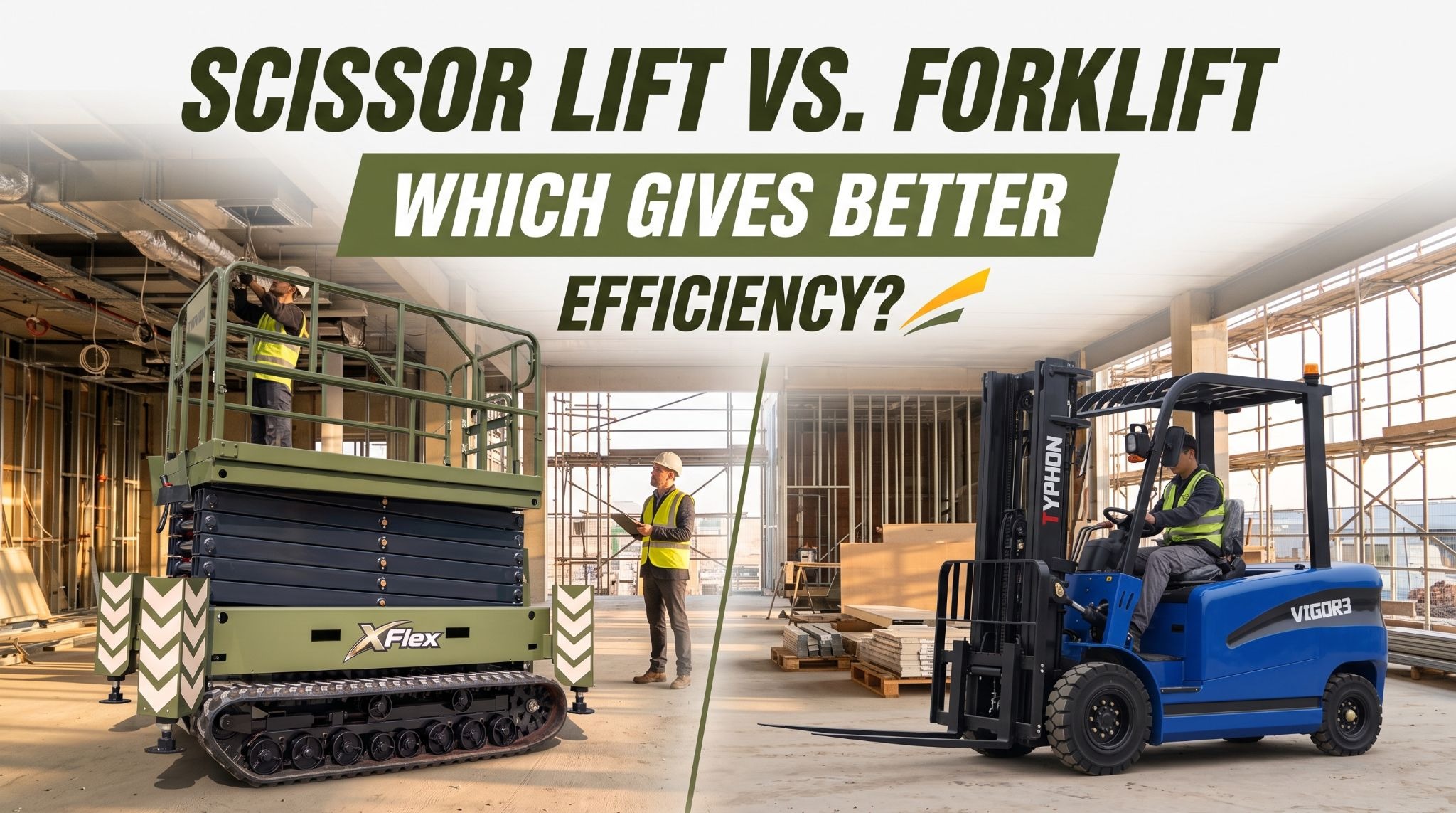
Scissor Lift vs. Forklift: Which Gives Better Efficiency?
Picking the wrong machine for a job can slow your entire crew and inflate your budget. Scissor lifts and forklifts are both jobsite workhorses, but they solve very different problems. One raises workers and their tools to elevated positions, while the other moves heavy loads across the ground with speed and control. Understanding where each machine shines is the fastest way to boost productivity, protect your team, and keep projects on schedule. This guide breaks down how these two machines compare across the factors that actually affect jobsite efficiency, so you can match the right equipment to the right task every time.
Different Jobs, Different Strengths
Scissor lifts and forklifts are engineered around two separate priorities, and that difference shapes every decision you make on-site. A scissor lift exists to elevate people and their tools to a stable working height. Its crisscrossing support mechanism raises a wide platform straight up, giving workers a secure place to install, inspect, or repair overhead systems. A forklift, on the other hand, is built to lift and transport materials. Its mast and forks slide under pallets, crates, and bulky loads, then carry them across the site with precision.
Trying to force one machine into the other’s role usually wastes time and money. A forklift can raise a load high, but it was never designed to serve as a safe elevated workstation for a crew. A scissor lift can carry a few items on its platform, yet it will never match a forklift for moving heavy pallets from a delivery truck to a staging area.
The smartest starting point is a simple question: does this task center on elevated access or material handling? When the goal is putting workers safely at height, the scissor lift leads. When the goal is moving, lifting, or stacking materials, the forklift takes over. Answering that question early prevents costly rentals of the wrong machine and keeps your workflow tight. Many jobsites actually need both, but knowing which strength applies to each task is what separates an efficient operation from one plagued by constant delays and repositioning.
Productivity at Working Height
When a job calls for sustained work above ground level, the scissor lift becomes a productivity multiplier. Its defining feature is a spacious, stable platform that supports multiple workers along with their tools and materials at the same time. Instead of climbing up and down a ladder or constantly shifting a smaller lift, a crew can settle into position and focus on the actual task. That steady footing translates directly into faster completion times and fewer interruptions.
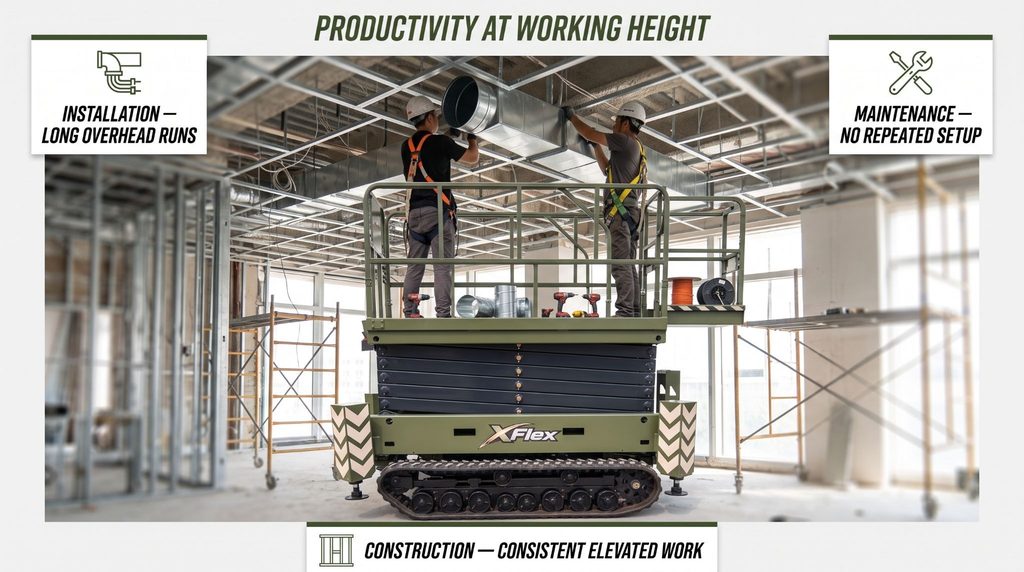
This advantage matters most in three types of work:
- Installation – running ductwork, wiring, lighting, or signage across long overhead spans
- Maintenance – servicing HVAC units, sprinkler systems, or ceiling fixtures without repeated setup
- Construction – framing, drywall, painting, and finishing at consistent elevated heights
Because the platform extends horizontally as well as vertically, workers can often cover a wide area from a single position. A scissor lift also allows a crew to keep the parts and equipment they need right beside them, cutting down on the wasted trips that eat into a workday.
Fewer repositioning cycles is where the real time savings appear. Every time a worker has to descend, move the machine, and climb back up, momentum breaks and minutes disappear. A scissor lift reduces that friction by offering a broad, secure surface that keeps the team productive for longer stretches. For projects where the bulk of the labor happens overhead, this machine keeps hands on the work and eyes on the details, which is exactly what drives efficient completion. When elevated access is the core requirement, few machines deliver the sustained output of a well-matched scissor lift.
Material Handling Efficiency
For moving weight across a jobsite, the forklift is purpose-built and hard to beat. Its mast and fork design lets it slide directly under pallets and loads, lift them cleanly, and set them down exactly where they belong. This gives the forklift a decisive edge over any scissor lift when the task is dedicated material handling. Where a scissor lift is optimized to raise people, the forklift is optimized to raise and relocate cargo, and that focus shows in its speed and lifting capacity.
Forklifts excel at the material tasks that keep a site supplied and organized:
- Moving pallets of bricks, tile, fasteners, and bagged materials
- Lifting and positioning heavy equipment or machinery components
- Stacking loads vertically to maximize storage in tight yards or warehouses
- Unloading delivery trucks quickly to keep receiving areas clear
The mast is the key to this efficiency. It allows precise vertical control, so an operator can stack materials several levels high and retrieve them just as easily. The forks provide a stable base for a wide range of load shapes and weights, and attachments can expand that versatility even further. This combination lets a single operator handle work that would otherwise require several laborers and far more time.
Efficiency here also comes from consistency. A forklift performs the same lift-and-carry cycle reliably, hour after hour, which makes it ideal for repetitive loading and staging tasks. When a project depends on keeping materials flowing to the right locations, the forklift removes bottlenecks and keeps crews stocked. Attempting the same volume of material movement with a scissor lift would stall progress, because that machine simply was not designed to transport heavy loads across distance.
Maneuverability Around the Jobsite
How a machine moves through a site is just as important as what it lifts, and here the two machines serve different movement patterns. A scissor lift is built for efficient travel between elevated work areas where vertical access is the priority. Once positioned, it raises straight up and stays put while the work happens, then relocates to the next station. This makes it well suited to jobs where the crew progresses from one overhead point to another, such as installing lighting down a long corridor or servicing fixtures across a large ceiling.
Forklifts are designed for a different kind of mobility. Their strength lies in transporting and positioning loads throughout the entire site. A forklift can pick up materials at a delivery point, carry them across the yard, and place them precisely at a staging or work area. That ground-level travel with a load is something a scissor lift cannot replicate.
Several conditions influence how well each machine maneuvers:
- Surface type – rough or uneven terrain favors rough-terrain models with the right tires
- Aisle and workspace width – tight indoor spaces reward compact, agile machines
- Travel distance – longer hauls between points favor the forklift’s transport strengths
- Height of the work – frequent vertical access favors the scissor lift’s stable platform
The practical takeaway is that maneuverability should be judged against the job’s dominant movement need. If the crew mostly moves upward and repositions between elevated spots, a scissor lift keeps them efficient. If materials constantly need to travel and be placed across the site, the forklift’s mobility wins. Matching the machine’s movement pattern to your workflow reduces downtime and keeps every phase of the project advancing smoothly.
Choosing for Overall Jobsite Efficiency
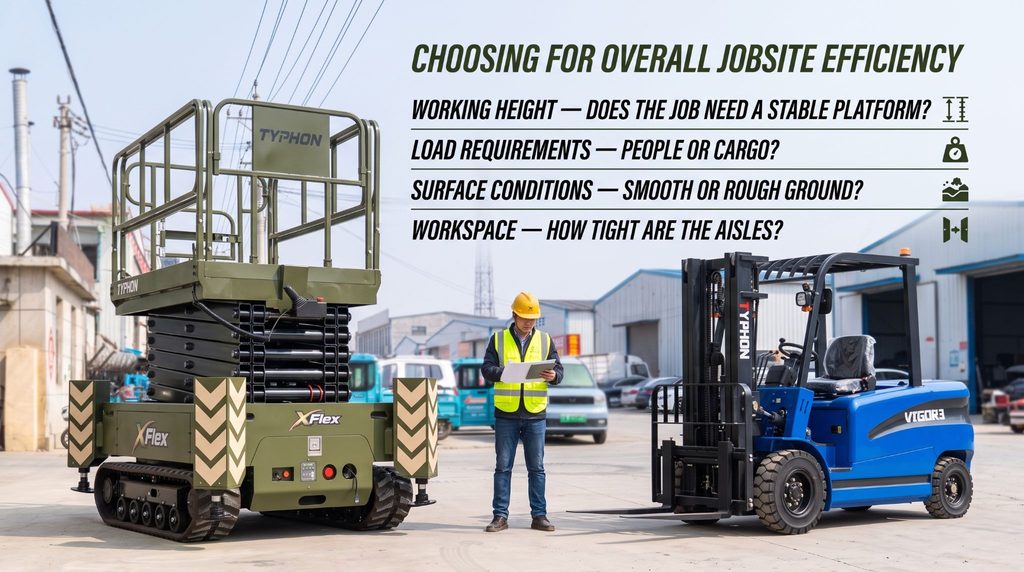
Neither the scissor lift nor the forklift is universally more efficient. The better machine is always the one that fits the task in front of you. Efficiency is not a fixed trait of the equipment; it is the result of a strong match between the machine’s strengths and the job’s demands. That is why experienced site managers evaluate the work carefully before committing to a rental or purchase.
Several factors should guide that decision:
- Working height – how high does the work sit, and will workers need a stable platform there?
- Load requirements – how heavy and how large are the materials that must be moved?
- Travel distance – how far do people or loads need to move across the site?
- Surface conditions – is the ground smooth and level, or rough and uneven?
- Workspace – how tight are the aisles, doorways, and work zones?
- Workers vs. materials – does the task lift people or lift cargo?
The final question on that list is often the fastest way to decide. If the job is fundamentally about lifting workers to a safe, productive height, the scissor lift is the efficient answer. If the job is about lifting, stacking, and transporting materials, the forklift delivers far more value.
Many busy jobsites need both machines running in parallel, each handling the work it does best. A forklift keeps materials flowing to the right places while a scissor lift keeps the crew productive overhead. Rather than asking which machine is better overall, ask which machine removes the most friction from each specific task. When you align the equipment to the work this way, efficiency follows naturally, and your project stays on time and on budget.
Conclusion
The scissor lift and the forklift are not competitors so much as specialists. A scissor lift gives your crew a stable, spacious platform for productive work at height, while a forklift moves, lifts, and stacks materials with speed and precision. Trying to substitute one for the other almost always costs you time, money, and momentum. The efficient choice comes down to reading the job accurately: elevated access points you toward the scissor lift, and material handling points you toward the forklift. Weigh your working height, load demands, travel distance, surface conditions, and available space, then match the machine to the task. Get that match right, and both machines will earn their keep on your jobsite.
Frequently Asked Questions
1. Can a forklift be used to lift workers like a scissor lift?
A standard forklift is not designed to elevate people and should not be used as a substitute for a scissor lift. Raising workers on forks or an unapproved platform creates serious safety risks. When elevated worker access is required, a scissor lift or a proper aerial work platform is the correct, safer choice.
2. Which machine is better for indoor work?
Both can work indoors, but the right pick depends on the task. Scissor lifts are ideal for overhead installation and maintenance in areas with adequate floor space and level surfaces. Forklifts suit indoor material movement and stacking, though you should confirm aisle width and choose a model rated for indoor use.
3. Do I need special training to operate either machine?
Yes. Both scissor lifts and forklifts require proper operator training and, in many regions, certification. Training covers safe operation, load limits, terrain awareness, and emergency procedures. Skipping this step increases accident risk and can create compliance problems, so always ensure operators are qualified before running either machine.
4. What surface conditions should I consider before choosing?
Surface conditions strongly affect performance and safety. Standard scissor lifts and forklifts work best on smooth, level ground, while rough or uneven terrain calls for rough-terrain models with appropriate tires. Always assess slope, ground stability, and obstacles so the machine can travel and lift safely throughout the job.
5. Is it worth renting both machines for one project?
For many jobsites, running both makes sense. A forklift keeps materials flowing to the right locations while a scissor lift keeps crews productive overhead. If your project involves significant elevated work alongside steady material movement, using both machines in parallel often improves overall efficiency and helps keep the schedule on track.